July 31, 2025
Duncan Holbrook-Smith, PhD
A common question that comes up when I talk to potential customers is whether GMet’s ultra-high-throughput flow injection analysis metabolomics platform is the right tool for their project, or whether a more traditional approach to metabolomics would be best (we offer those too). There are multiple factors that contribute to answering this question, but given the substantial savings in time and money that the technology can provide, it’s worth getting right. In this post, I’ll lay out how I go about answering that question and how you can think about choosing the right tool for your metabolomics project.
A short answer is the following: if you have hundreds or thousands of samples and you want to get a rapid, high-quality answer about the relative levels of a broad array of metabolites with annotation at the level of molecular formula rather than molecular structure, then our ultra-high-throughput flow injection analysis method is probably a good fit for you. If you have fewer than 100 samples and you want to know the absolute concentration of a specific set of metabolites to address your biological question, or require a very high annotation confidence, then flow injection is probably not the right tool to apply. To explain why this is, first let’s get into what flow injection analysis metabolomics is (see figure1).
First, I want to describe the more traditional tool, liquid chromatography-mass spectrometry (LC-MS), where a sample is subjected to chromatographic separation by interacting with the stationary phase in a column before it reaches the mass spectrometer. In this process the various small molecules that make up the sample are separated from each other based on differences in how they interact with the column. This can be based on their hydrophobicity, their pKa, or combinations of those and other chemical properties. The main take-away is that chromatographic separation means that the different compounds that make up the sample arrive at the mass spectrometer for analysis at different times. The mass spectrometer is then able to measure the mass-to-charge ratios (m/z) of the ions that are generated from the compounds that make up the sample. The combination of those m/z values and how long the compound was retained on the chromatographic column (the “retention time”, or RT) can then be compared to libraries of the known compound m/z values to annotate the ion to a particular compound. Note that this retention time is not an inherent molecular property of a metabolite but is entirely dependent on the chromatography system that is used. It is also worth noting that because no chromatography system can perfectly separate all compounds, some compounds with the same formula will still co-elute even when using LC. The relative amounts of the annotated compounds can then be estimated between different samples based on the intensity of the signal arising from them. In short, when performing LC-MS each “feature” is defined by its RT and m/z.
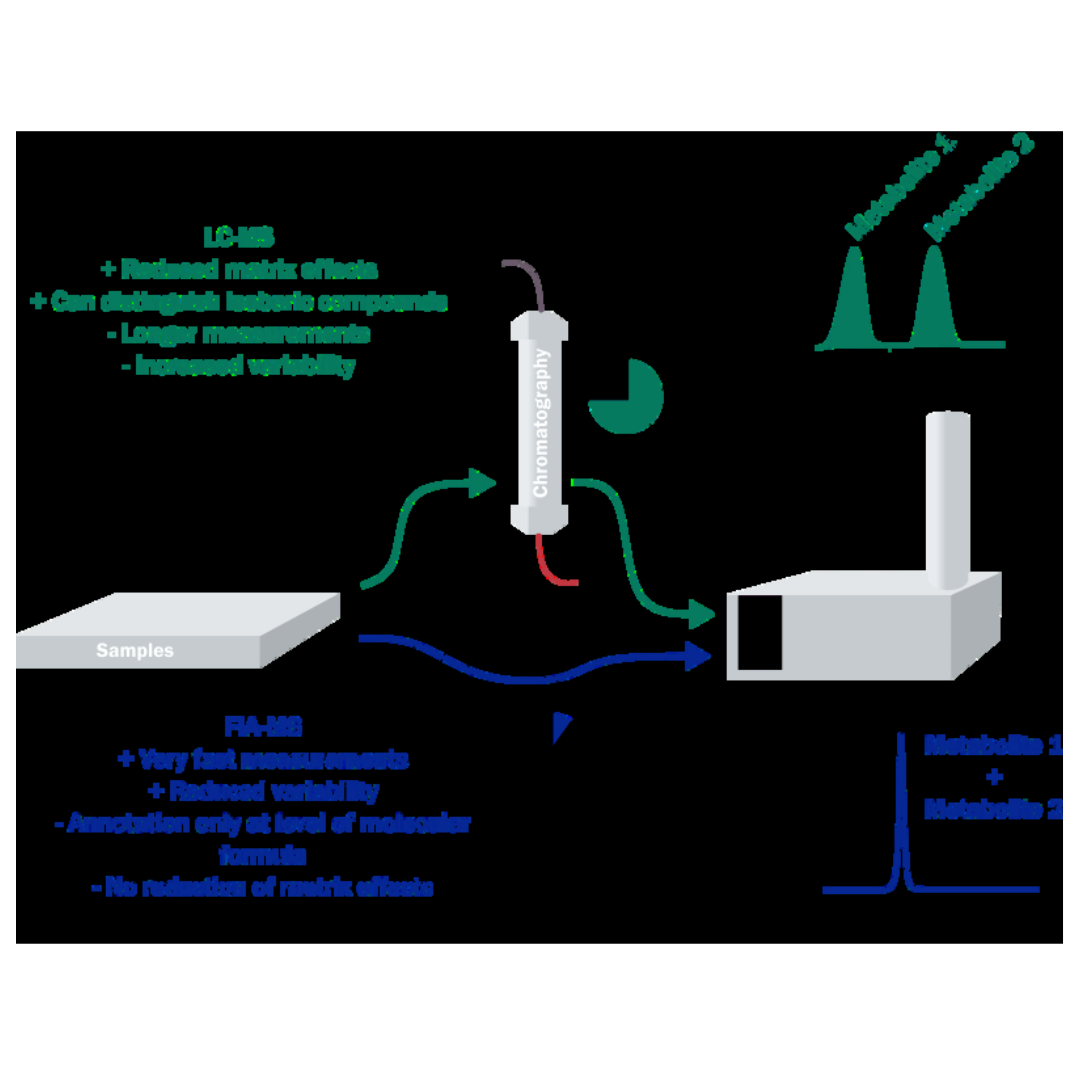
By contrast, in flow injection analysis (FIA) this chromatographic separation is omitted. Our FIA platform was developed in collaboration with its creators at the ETH Zurich, and was initially published in Fuhrer et al.). This means that each feature that is detected is only defined by an m/z value. Because of advances in high-resolution mass spectrometry and GMet’s proprietary signal processing algorithms, we are able to annotate features with a stringent m/z window (less than 1 mDa) this m/z corresponds to a single annotated molecular formula in more than 90% of cases. For most molecular formulae this is extremely informative, especially in mammalian samples. As an example, the formula C5H9NO4 may correspond both to glutamate and N-methyl-D-aspartic acid, but if there is a change in the intensity of that feature it is highly likely to be driven by changes in the amount of glutamate rather than any other lower-abundance metabolites that may share its molecular formula. Even for metabolites where there are two or more important metabolites that may be present at similar concentrations, a change in feature abundance can be very informative, e.g. leucine and isoleucine cannot be distinguished by molecular formula, but in either case one is seeing a change in a branched chain amino acid metabolism. Even so, there are clearly cases where this limitation matters for the biological interpretation of an experiment, making it an important consideration.
So, what are the advantages of running FIA? The main advantages are time and cost, making FIA an attractive entry point to explore metabolism. Chromatographic separation requires time, and some chromatographic gradients, especially for untargeted metabolomics, need 30 minutes or longer per sample. In the last few years, the lengths of those gradients are decreasing but all other things being equal, having a chromatographic system cannot be faster than not having it. A FIA study with 1,000 samples can be measured in one day, whereas the same study could take more than a week when chromatography is included. And even if you are patient, the reality is that the longer your measurements take, the more expensive and prone to instrument variability they will be (see below). The speed of acquisition, as well as reduced consumption of lab materials, means that FIA studies can be much, much less expensive than an equivalent LC-MS study. GMet also typically delivers FIA results within 2 weeks after samples arrive, whereas LC-MS studies are often more iterative and therefore generally take longer to deliver.
GMet’s implementation of FIA also offers high sensitivity compared to many LC-MS methods. Any time a sample is diluted it becomes harder to detect any specific analyte within it. In LC-MS the samples are effectively diluted in the buffers that are used to wash the compound off the column. This means that a FIA study can sometimes be more sensitive than an equivalent LC-MS study. This, together with annotation being based on MS1 alone, translates into typical numbers of annotated ions from a single FIA experiment being more than 1,000 where a more typical number for a single LC-MS analysis is in the low hundreds.
Overall dataset quality is also an important factor, and FIA studies are quite robust. One major source of experimental noise in LC-MS studies relates to the drift in the retention times for the compounds that are being detected. In FIA that drift in retention time is completely eliminated. Of course, this increased robustness comes from having no retention time, but for very large studies that can prove an advantage since that source of uncertainty is known, whereas a variability arising from retention time drift in LC-MS can cause unexpected variability and lead to an overinterpretation of data.
One final point is worth making here: often the right question to ask when planning a metabolomics study is not “what is the one method I can use to fulfill all my objectives” but rather “what tools can I combine to get the best results quickly and at the best cost?” FIA excels in hypothesis generation, and especially in the context of large studies. LC-MS approaches excel in providing high confidence annotations and/or reporting actual concentrations for metabolites, especially in more focused sample sets, and these are also approaches we here at GMet offer. These strengths can be combined into workflows where an initial large metabolomics screen is performed using FIA, and then LC-MS can be used to validate those specific findings. In this way the cost and time required for the study can be significantly reduced, but the annotation confidence for the relevant targets is just as high as it would have been had the whole study been conducted by LC-MS. Of course, these are just guidelines and you should feel free to reach out to us if you have any questions or are thinking about planning your own study!