May 19, 2026
Duncan Holbrook-Smith, PhD
“This looks great! So what does all of this mean?”
That’s a question that I’ve often gotten after walking through the results of a metabolome or lipidome profiling project with a customer. Usually it comes after they’ve been made aware of all of the ways they can look at their data reports, what those reports show, and how they can use our interactive visualization app to explore their data.
Depending on the customer and the experimental design, there may be an obvious answer to this question; but sometimes the answer is a little less clear. Crucially, this challenge is not generally a property of the experimental limitations that are discussed when it comes to untargeted metabolome profiling (lack of absolute quantification, annotation uncertainty, technical variability, study design). Often the challenge is an intrinsic property of comparative steady-state metabolome profiling.
In a typical untargeted metabolomics or lipidomics experiment, the experiment shows the relative metabolite pool sizes for the annotated metabolites in the various samples that were included in the study. Pool sizes are very useful in many contexts, but they intrinsically serve as a static snapshot of the metabolic state of the cell.
For example, if a drug treatment results in an increase in the level of a particular metabolite, this can be the result of several different processes. Maybe the drug stimulates the production of that metabolite. It could also suppress the consumption of the metabolite by other reactions. It could also result in an increase in the transport of that metabolite from the cell’s surroundings. Even this list of options can understate the challenges faced in interpreting this kind of data since many metabolites are produced and consumed simultaneously via multiple different enzymatic pathways.
All of this is to say that other methods are needed if a scientist wants not only to understand what metabolites are changing in abundance, but also why and how metabolites are changing.
That’s where isotopic labeling comes in.
In isotopic labeling studies, metabolites that are enriched for stable isotopes of carbon, nitrogen, or hydrogen are included in the experimental design. These metabolites are essentially indistinguishable from naturally occurring metabolites from the perspective of the metabolic system, but they serve as a type of “dye marker” when tracking metabolism. By treating the system with these labeled metabolites, it is often possible to track which other metabolites are being produced from the labeled metabolite and whether the isotopic label is accumulating in those different metabolites at different rates. This can allow the researcher to disentangle whether changing metabolite pool sizes are due to increased production, reduced consumption, or extracellular transport. In other words, metabolomics measures metabolite abundance, while isotope tracing provides a window into metabolic flux.
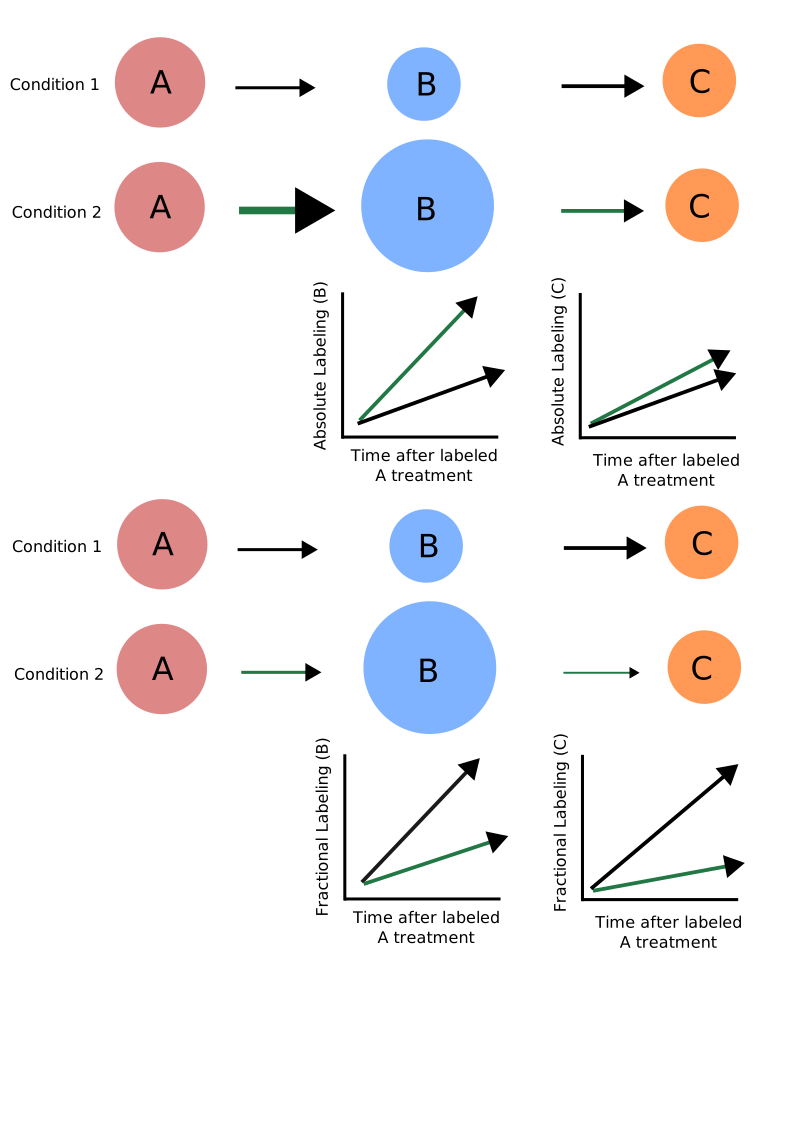
In practice, metabolic flux is assessed by comparing the rate of accumulation of the labeled form of the metabolite both in absolute terms and as a fraction of the total signal attributable to that metabolite. In a linear unbranched pathway, if the increased abundance of a metabolite is driven by increased biosynthetic flux, the rate of production of the labeled form of the metabolite should be higher in that condition compared to a control (Figure 1, top panel). If, on the other hand, the increased abundance is due to reduced consumption, the fraction of the metabolite that is labeled will increase more slowly compared to a control despite the overall quantity of the metabolite being higher. This reflects the label entering a larger pool that is being drained more slowly (see Figure 1, bottom panel). In real pathways and biological systems, there can be numerous other considerations that can make sophisticated mathematical modeling necessary;, however, these toy examples serve to illustrate the fundamental difference between metabolite pool sizes and relative rates of pathway flux.
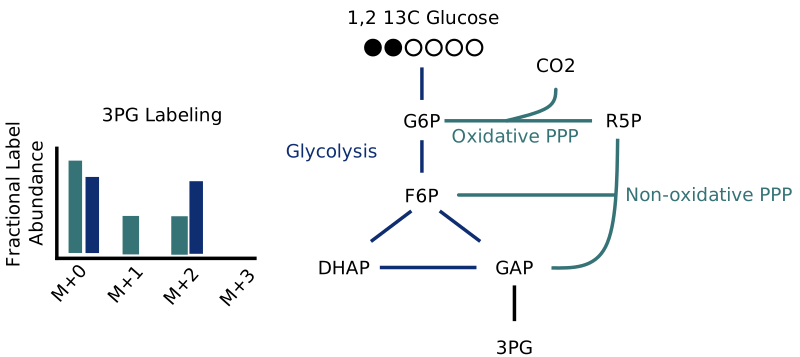
Isotopic labeling can also provide estimates of the relative flux between different metabolic pathways. This is often done by selecting isotopically labeled metabolites where the label is included at specific positions within the feed metabolite. When those two labeled positions are incorporated into separate molecules in downstream metabolic reactions, the relative amounts of label in those different metabolites are indicative of the relative pathway flows. In the most informative cases, labels that are separated may subsequently re-converge into the same downstream molecule. For example, when cells are treated with glucose for which the carbons at positions 1 and 2 are 13C-labeled, it is fairly straightforward to disentangle the relative fluxes through glycolysis compared to the pentose phosphate pathway (PPP). 3-phosphoglycerate (3PG) generated from glycolysis will be composed of +0 and +2 isotopologues, whereas 3PG generated from the PPP has a significant portion of the +1 isotopologue due to the loss of carbon 1 during the oxidative phase of that pathway. This means that the ratio of +1 to +2 3PG can serve as a proxy for flux passing through PPP (Figure 2) relative to glycolytic flux. This can be very relevant given the important role of PPP in maintaining NADPH pools which are in turn crucial in biosynthesis and the cellular management of oxidative stress.
For researchers studying metabolism, combining metabolome profiling with isotope tracing provides a much richer picture of cellular metabolism. While metabolomics reveals which metabolites change across conditions, isotopic labeling uncovers the pathways and fluxes that drive those changes. At General Metabolics (GMet) we help researchers design and execute isotope tracing experiments and integrate them with metabolomics datasets to extract deeper biological insight.
Are you interested in incorporating isotope labeling into your metabolomics experiment? Contact GMet for support with experimental design and analytical strategies tailored to your study.